


There’s no shortage of advice about how to earn more, invest more, or save more. But when your household income crosses $500,000, the conversation that actually matters tends to change, and it’s one most people aren’t having: how do you keep more of what you’ve already earned? Not through loopholes or aggressive positions, but through deliberate, forward-looking tax planning strategies that work within the current rules.
The strategies below aren’t obscure. Most high-income professionals have heard of at least a few of them. However, the difference between knowing that a Roth conversion exists and knowing whether one makes sense for you in 2026, given the permanence of the current rate structure under the One Big Beautiful Bill Act, is the difference between a concept and a plan.
How to Reduce Your Taxable Income as a High Earner
Before getting into specific strategies, it helps to understand the framework. For high-income earners in the 35% or 37% federal brackets (for 2026, single filers above $243,725 and $640,600 respectively, or married filing jointly above $487,450 and $768,700, subject to change), every dollar of taxable income reduction is worth more because the marginal rate is higher. A $10,000 reduction at a 37% rate saves $3,700 in federal tax alone, before state taxes.
There are three primary mechanisms for reducing taxable income: contributing to tax-deferred accounts (which shifts income to a future year), harvesting investment losses (which offset gains), and timing deductions strategically (which concentrates write-offs in years where they deliver the most benefit). Each of the sections below maps to one or more of these strategies.
The goal isn’t to minimize taxes in isolation. It’s to coordinate your tax decisions with your investment decisions and your cash flow, so that the strategies reinforce each other rather than working at cross purposes.
Max Out Every Tax-Advantaged Account Available to You
We generally recommend starting here because it is the most reliable dollar-for-dollar reduction most high earners have access to, and because it compounds. Each of these accounts offers a distinct tax benefit, and in most cases you can use all of them simultaneously.
401(k) and employer plans. The 2026 contribution limit is $24,500 (subject to change). If you’re 50 or older, the catch-up contribution adds $8,000. If you’re between 60 and 63, the catch-up is $11,250 under the SECURE 2.0 enhanced catch-up provision. Employer matching, if available, is additional. For a married couple both maxing out employer plans with the standard catch-up, that’s $65,000 in pre-tax contributions before matching, and every dollar reduces your adjusted gross income.
If your plan allows after-tax contributions beyond the pre-tax limit, a mega backdoor Roth conversion can be one of the most efficient ways to move additional money into a Roth account. Not every plan offers this, but for those that do, it’s worth understanding how it works.
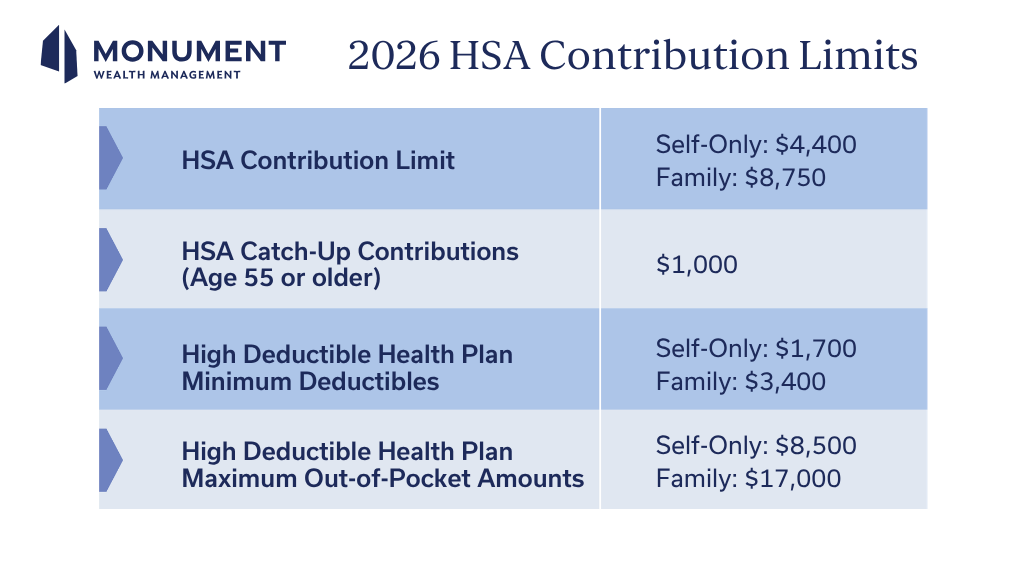
Health Savings Account (HSA). The HSA is, dollar for dollar, one of the most tax-efficient accounts in the code. Contributions are pre-tax (reducing AGI), growth is tax-deferred, and withdrawals for qualified medical expenses are tax-free — a triple benefit that no other account type offers. For 2026, the limits are $4,400 for self-only coverage and $8,750 for family coverage, with an additional $1,000 if you’re 55 or older (all subject to change). You need a high-deductible health plan to qualify.
Here’s where the compounding really packs a punch. Consider a hypothetical scenario: a 45-year-old contributing the family maximum of $8,750 per year, invested in a diversified portfolio earning a hypothetical 7% annual return. By age 65, those contributions alone, roughly $175,000 over 20 years, could grow to approximately $380,000. In a taxable brokerage account with the same contributions and returns, federal and state taxes on dividends, interest, and realized gains along the way would reduce that accumulation. At a blended annual tax drag of roughly 1.5% on a 7% return, the after-tax accumulation in a taxable account might be closer to $310,000 over the same period. That $70,000 gap is the triple-tax advantage compounding over two decades, and it’s available to be withdrawn tax-free for qualified medical expenses, which tend to be more substantial in retirement.
If you can afford to pay current medical expenses out of pocket rather than drawing from the HSA, the math tends to favor doing so. The longer those dollars stay invested, the larger the tax-free pool becomes.
Traditional and Roth IRAs. The 2026 contribution limit is $7,500, with an additional $1,100 catch-up if you’re 50 or older (subject to change). Roth IRA income phase-outs for 2026 begin at $153,000 for single filers and $242,000 for married filing jointly (subject to change). If your income exceeds those thresholds, a backdoor Roth contribution (contributing to a traditional IRA and converting to Roth) remains available, though it requires careful handling of the pro-rata rule if you hold other pre-tax IRA balances.
Roth Conversions Under the Current Rate Structure
The One Big Beautiful Bill Act made the Tax Cuts and Jobs Act individual tax rates permanent, which changes the Roth conversion calculus for many high earners. Before the OBBBA, the argument for converting was partly defensive: lock in current rates before they revert to higher pre-TCJA levels in 2026. That reversion risk is now off the table.
However, that doesn’t mean Roth conversions have lost their value. If you expect your income to be lower in a particular year — between retirement and the start of Social Security or required minimum distributions, for example — converting a portion of traditional IRA or 401(k) balances to Roth during that window can still produce meaningful tax savings over your lifetime. The key is identifying years when your marginal rate is temporarily lower than your expected long-term rate.
There’s also an estate planning dimension. Roth assets pass to heirs income-tax-free, while traditional retirement assets are taxed as ordinary income to the beneficiary under the 10-year distribution rule. For high-income earners whose heirs are also likely to be in elevated brackets, the intergenerational math can favor paying the tax now.
All of this to say: the decision is not whether a Roth conversion makes sense in the abstract. It is whether the math works this year, given your income, your expected future rate, and your estate plan. That requires running the numbers with your wealth advisor and your CPA.
Tax-Efficient Investing
Your investment strategy and your tax strategy are intertwined — or they should be. Tax-loss harvesting is the most direct example: selling positions at a loss to offset realized gains elsewhere in the portfolio, reducing your net capital gains tax. The harvested losses can offset capital gains dollar for dollar, and up to $3,000 of net losses per year ($1,500 if married filing separately) can be applied against ordinary income, with unused losses carrying forward indefinitely.
Beyond loss harvesting, the placement of investments across account types is one of the most overlooked levers in a high-income tax plan. Holding tax-inefficient assets (high-yield bonds, actively managed funds, REITs) in tax-deferred accounts and tax-efficient assets (index funds, growth stocks you intend to hold long-term, municipal bonds) in taxable accounts can meaningfully reduce your annual tax drag without changing your investment allocation or risk profile.
For high earners subject to the 3.8% Net Investment Income Tax (NIIT), which applies to the lesser of net investment income or MAGI exceeding $200,000 single / $250,000 married filing jointly, the combined top rate on long-term capital gains reaches 23.8%. Tax-efficient asset allocation and strategic gain/loss management become more impactful at these levels.
Deductions and Write-Offs That You Should Know
The 2026 standard deduction is $32,200 for married filing jointly and $16,100 for single filers (subject to change). For high-income earners who itemize, several deduction categories deserve attention.
State and local tax (SALT) deduction. The OBBBA raised the SALT cap from $10,000 to $40,400 for 2026 (subject to change). This is a meaningful change for high earners in states like Virginia, Maryland, and D.C., where state income taxes and property taxes together can easily exceed the old cap. However, the deduction phases out for taxpayers with modified AGI above $505,000 and reverts to $10,000 after 2029 under the current sunset schedule.
Charitable giving. Donating appreciated stock directly to a qualified charity or donor-advised fund eliminates the capital gains tax on the appreciation and generates a deduction at the stock’s full fair market value. For high earners with concentrated stock positions, this can be one of the most efficient ways to support causes you care about while reducing your tax liability. Bunching charitable contributions into a single year through a DAF, particularly in years when your income is elevated, can also maximize the deduction benefit relative to the new 0.5% AGI charitable deduction floor introduced by the OBBBA.
Qualified business income (QBI) deduction. If you have pass-through income from an S-Corp, partnership, or sole proprietorship, the 20% QBI deduction can reduce your effective rate on that income. Phase-outs apply for specified service businesses above $197,300 single / $394,600 married filing jointly for 2026 (subject to change). This is primarily relevant for high earners with business income, not W2 professionals.
A Note for W2 Earners
Much of the tax planning content online is written with business owners and self-employed professionals in mind, people who can shift income timing, deduct business expenses, and choose their entity structure. If you earn the bulk of your income from a W2 salary and equity compensation, your deduction universe is narrower, which makes the strategies you do have access to more important, not less.
For W2 earners, the core playbook is: maximize pre-tax retirement contributions (including mega backdoor Roth if available), fund the HSA, time your equity compensation events strategically, and manage asset allocation across account types. If you receive RSUs or other stock-based compensation, understanding how RSUs are taxed and the key differences between ISOs and NSOs — and particularly the gap between supplemental withholding rates and your actual marginal rate — can prevent unwelcome surprises at tax time.
The withholding gap is one of the most common planning failures we see among high-earning W2 professionals. Most employers withhold federal taxes on RSU vests at the 22% supplemental rate. If your total income places you in the 35% or 37% bracket, the difference between what was withheld and what you owe can be substantial — and it compounds when multiple tranches vest in the same calendar year.
What to Do Next
Tax strategy for high-income earners isn’t about any single move — it’s about how the pieces fit together. Your retirement contributions, your investment allocation, your equity compensation timing, your charitable giving, and your deduction strategy all interact, and optimizing one in isolation can create problems elsewhere.
The value of a coordinated approach tends to increase with income, because the stakes on each decision are higher and the interactions between decisions become more complex. That’s the kind of work we do at Monument — connecting the tax decision to the investment decision to the cash flow plan, so they work together across years rather than in a single filing season.
For more context on Roth conversion strategies and how they fit into a broader tax plan, watch our discussion on Off the Wall.
If you’d like to talk through how these strategies apply to your specific situation, we offer a Complimentary Wealth Check to get started. Let’s talk.
