


Yes, 529 contributions are tax deductible in Virginia, and for residents willing to think strategically about how they structure those contributions, the annual tax benefit can be substantially larger than the $230 most people assume.
Virginia allows a state income tax deduction of up to $4,000 per account, per year for contributions to Virginia’s 529 plan (Invest529). That’s per account and per beneficiary, which is an important distinction because it means the deduction isn’t a flat cap on your household. It scales with how many accounts you open and who owns them.
At Virginia’s top marginal income tax rate of 5.75% (for the 2026 tax year, subject to change), each $4,000 contribution translates to $230 in state tax savings. But the real opportunity isn’t in a single account, but in the structure.
How Virginia’s 529 Tax Deduction Works
The core mechanics are straightforward. Virginia residents who own an Invest529 account can deduct contributions up to $4,000 per account from their Virginia adjusted gross income each year. A few things worth knowing about how the rules work in practice:
The deduction is per account, per owner, per beneficiary. This is the detail that creates the most planning opportunity, and we’ll walk through exactly how below.
There is no income limit. Unlike some federal tax benefits that phase out at higher income levels, Virginia’s 529 deduction is available to every Virginia taxpayer regardless of income. For the 2026 tax year, this remains the case (subject to change).
Excess contributions carry forward. If you contribute more than $4,000 to a single account in a given year, you can carry the excess forward and deduct it in future tax years. There is no expiration on the carry-forward (as of 2026, subject to change). This is particularly useful for families who want to front-load contributions while their cash flow allows it.
No minimum holding period. Unlike some states, Virginia does not require your money to remain in the 529 for any minimum period to qualify for the deduction. You can contribute, claim the deduction, and withdraw the funds for qualifying education expenses in the same year. That said, the real power of a 529 comes from tax-free compounding over time, so pulling funds out early means forgoing one of the account’s most valuable features.
Age 70 and over: the cap disappears. If the account owner is 70 or older, the $4,000 annual limit does not apply. The full amount of the contribution can be deducted in a single year (for the 2026 tax year, subject to change). This opens a meaningful planning window for grandparents and retirees, which we’ll cover below.
Contribution Limits and Maximum Balances
Virginia’s 529 plan does not impose an annual contribution limit. You can contribute as much as you’d like in a given year. The $4,000 figure is the annual deduction limit per account, not a contribution cap.
However, there is a maximum account balance. As of January 1, 2026, the lifetime maximum balance across all Virginia 529 accounts for a single beneficiary is $675,000, including earnings (subject to change). This was increased from $550,000 and reflects one of the higher state limits nationally. Once the combined balance reaches this threshold, additional contributions are not accepted until the balance falls below it.
For families thinking about how much to save for college, the $675,000 ceiling provides significant room, even for families planning to fund private university tuition for multiple years.
Multiple Accounts, Bigger Deductions
This is where the Virginia 529 deduction becomes genuinely interesting for higher-income families, and it’s the detail most people overlook.
Because the $4,000 deduction applies per account, per owner, per beneficiary, a married couple can multiply the deduction by opening accounts strategically. Each parent can own a separate account for each child. Each parent can also open an account naming themselves as beneficiary (with the intent to change the beneficiary to a child later), and each spouse can open an account for the other.
Consider a hypothetical scenario: a married couple living in Northern Virginia with two children. They open the following accounts:
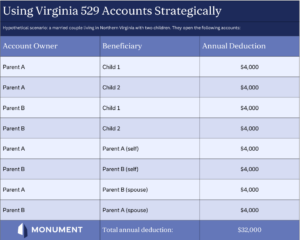
Total annual deduction: $32,000. At Virginia’s 5.75% top rate, that translates to $1,840 in annual state tax savings (for the 2026 tax year, subject to change).
That is a meaningful number, and it compounds year over year. Over a decade of consistent contributions and deductions, this structure could generate over $18,000 in cumulative state tax savings alone, before accounting for the tax-free growth inside the accounts.
A few caveats. Beneficiary changes can be made to another qualifying family member without income taxes or penalties, which is what makes the self- and spouse-beneficiary accounts viable. However, changes can potentially trigger gift tax implications, and managing eight accounts requires real administrative discipline. For many families, a simpler four-account structure — both parents contributing for each child, totaling a $16,000 deduction — captures most of the benefit with less complexity.
Virginia’s “In and Out” Strategy
Virginia’s lack of a minimum holding period creates a distinctive planning opportunity. Families with qualifying education expenses due in the current year can contribute to a Virginia 529, claim the state income tax deduction, and withdraw the funds for those expenses — all within the same tax year.
This can be a smart move for families already paying tuition or college costs out of pocket. Rather than paying directly, routing the payment through a 529 generates the state tax deduction on money you were going to spend anyway — a $230 savings per $4,000 contributed, for what amounts to a brief detour in how the dollars flow.
Lump-Sum Gifting and the Age 70+ Advantage
For grandparents and older family members, Virginia’s 529 rules create a particularly powerful combination. Two provisions work together here.
First, the federal gift tax code includes a special election for 529 contributions: you can contribute up to five years’ worth of the annual gift tax exclusion in a single year without triggering a gift tax return. For 2026, the annual exclusion is $19,000 per person (subject to change), which means an individual can contribute up to $95,000 in one year, or a married couple can contribute up to $190,000 through gift-splitting, all to a single beneficiary’s 529.
Second, Virginia’s age 70+ rule removes the $4,000 annual deduction cap entirely. An account owner who is 70 or older can deduct the full amount of their Virginia 529 contribution in the year it’s made.
These two provisions together mean a grandparent over 70 could contribute $95,000 to a grandchild’s Invest529 account and deduct the entire amount from Virginia taxable income in that same year. At the 5.75% rate, that’s a hypothetical state tax savings of $5,462 in a single year (for the 2026 tax year, subject to change) — a significant offset for retirees managing required minimum distributions from tax-deferred retirement accounts.
For grandparents who want to reduce the size of their taxable estate while funding education for the next generation, the combination of front-loaded gifting and Virginia’s unlimited deduction for those 70 and over can be one of the more effective state-level tax strategies available.
What If You Overfund?
One of the most common hesitations about 529s is the fear of overfunding. The concern is understandable, but the flexibility built into these plans has expanded substantially.
If a beneficiary doesn’t use all of their 529 funds for education, the account owner can change the beneficiary to another qualifying family member — a sibling, a cousin, or even a future grandchild — without taxes or penalties. Unused funds can also be applied to graduate school, trade school programs, and certain apprenticeship costs.
And under the SECURE 2.0 Act, beneficiaries of 529 accounts that have been open for at least 15 years can now roll unused funds into a Roth IRA, up to a $35,000 lifetime limit (subject to change). The rollover is subject to annual Roth IRA contribution limits, and the transferred funds must have been in the account for at least five years. But for families who started saving early and find themselves with excess 529 balances, this provides a meaningful retirement head start for the beneficiary.
Frequently Asked Questions
Is there an income limit for the Virginia 529 tax deduction?
No. Virginia’s 529 deduction is available to all Virginia taxpayers regardless of income level, for the 2026 tax year (subject to change).
Can I deduct contributions to an out-of-state 529 plan on my Virginia taxes?
No. The deduction applies only to contributions made to Virginia’s own 529 plan, Invest529. Contributions to out-of-state 529 plans are not deductible on your Virginia return.
Does the beneficiary need to live in Virginia?
No. As long as the account owner is a Virginia resident contributing to Invest529, the deduction applies regardless of where the beneficiary lives. The funds can also be used at any eligible institution nationwide.
How does the deduction work for married couples filing jointly?
Each spouse can own separate accounts and claim the $4,000 deduction per account. A couple with two children can deduct up to $16,000 annually using four accounts — or more with the expanded structure described above (for the 2026 tax year, subject to change).
Can I use 529 funds for K–12 expenses?
Federal law permits up to $20,000 per year in 529 withdrawals for K–12 tuition and certain education expenses as of the 2026 tax year (subject to change). However, Virginia’s state tax conformity with these expanded federal provisions may vary, and withdrawals used for K–12 expenses could potentially trigger a recapture of previously claimed state deductions. Consult your CPA before using 529 funds for K–12 costs in Virginia.
What to Do Next
Virginia’s 529 tax deduction is one of the more underutilized state-level tax benefits available to residents, particularly for families with the income and cash flow to fund multiple accounts. The mechanics are straightforward, but the strategy behind them is where the real value comes from: which accounts to open, how to coordinate between spouses, when grandparents should get involved, and how the 529 fits into your broader tax and education funding strategy.
If you’re a Virginia resident weighing how to structure your family’s 529 contributions, or if you’re trying to determine where education funding fits within your overall wealth plan alongside retirement, tax planning, and everything else on your plate, this is exactly the kind of decision that benefits from having a thinking partner. We work with families in the DC Metro area who are navigating these kinds of college savings decisions every day.
Let’s talk. A complimentary Wealth Check is a good place to start — no pressure, just a clear-eyed look at where things stand and whether there’s an opportunity you might be leaving on the table.
